I'm compiling a list of independent bookshops, photography bookshops and those with a good photography section. Here's what I have so far...
PHOTOGRAPHY SPECIALISTS
Photo Books International
99 Judd Street, London WC1H 9NE
Tel: 020 7813 7363
Website unknown/defunct
Open Wednesday to Saturday (Wednesday to Friday 11.00 to 5:30, Saturday 12.00 to 17:00).
Specialist in photography monographs. I believe their current email address is pbi-books@blueyonder.co.uk.
Photo book stock ****
Ambience: **, piled high, claustrophobic, functional
Claire de Rouen Books
1st Floor, 121–125 Charing Cross Rd, London
http://www.clairederouenbooks.com/
Good selection of new photographic monographs.
Note: it’s upstairs, above Soho Original Books (‘Sex Shop and Bargain Books’)...
Photo book stock ***
Ambience: **
The Photographers’ Gallery Bookshop
16–18 Ramillies Street, London W1F 7LW
Their new home.
Photo book stock ****
Ambience ***
Mike Wells
Unit 11, Spectrum House, 32–34 Gordon House Road, Kentish Town, London, NW5 1LP.
Tel: 0207 284 3306. Fax: 0207 485 6347. No web site.
I haven't visited, but apparently has thousands of photo books in stock.
ART BOOKSHOPS
Koenig Books
80 Charing Cross Road, London WC2H 0BF
Art bookshop with some photography books. Some great bargains downstairs.
Photo book stock ***
Ambience: **, German
Arnolfini Bookshop
6 Narrow Quay, Bristol BS1 4QA
Art bookshop attached to the harbourside Arnolfini gallery. Closed Mondays.
Photo book stock **
Ambience: ***, arty
GENERAL BOOKSHOPS
Foyles
113-119 Charing Cross Road, London WC2H 0EB, UK
http://www.foyles.co.uk/
Huge bookshop with more than 200,000 titles and a colourful history. Foyles is still independently owned by the Foyle family, and has an excellent photography section (plus loads of notices telling you photography is strictly prohibited).
Open Monday to Saturday: 9.30 am to 9.00 pm; Sundays: 11.30 am to 6.00 pm
Photo book stock ****
Ambience: ****
Mr B's Emporium
14–15 John Street, Bath BA1 2JL, UK
http://www.mrbsemporium.com/
Nice independent general bookshop with good photography section upstairs and knowledgeable staff.
Photo book stock **
Ambience: ****, tweedy
Topping & Company
The Paragon, Bath BA1 5LS
9 High Street, Ely CB7 4LJ
http://www.toppingbooks.co.uk/
Lively bookshops in Bath and Ely. Well, I haven’t actually been to the Ely one, but the new-ish Bath bookshop is very convivial, with numerous events, a pleasant shopping area, and a good selection of photo books.
Photo book stock **
Ambience: ****, tweedy again
P S Brighton (formerly Sandpiper Books)
34 Kensington Gardens, North Laine,
Brighton BN1 4AL, UK
Cheap art, architecture and academic books. This shop has been here since the beginning of time.
Photo book stock **
Ambience: **
AUGGGHHHHH - CLOSED IN 2017!
The Kemp Town Bookshop
91 St George's Road, Kemp Town, Brighton BN2 1EE, UK
http://www.kemptownbookshop.co.uk/
Pleasant independent general bookshop in a quiet-ish, interesting part of Brighton.
Photo book stock *
Ambience: ****, tweedy
Words, etc.
2 Cornhill, Dorchester DT1 1BA, UK
http://www.wordsetcetera.co.uk/
CLOSED JULY 2011
Judd Books
82 Marchmont Street, London WC1N 1AG
http://www.juddbooks.com/
Open 11am to 7pm Monday to Saturday, 12 to 6pm Sundays
Used and bargain academic books on two floors in Bloomsbury. Well worth a browse.
Photo book stock *
Ambience ***
Housmans
5 Caledonian Road, Kings Cross, London N1 9DX, UK
http://www.housmans.com/
Smallish bookshop specialising in books, zines and periodicals concerning progressive and radical politics, green issues and psychogeography (Iain Sinclair, Situationism, etc). One of Britain's last radical bookshops. Hosts events.
Open: Monday to Friday: 10 am to 6.30 pm; Saturday: 10 am to 6 pm; check website for Sunday opening.
Photo book stock: not much
Ambience: The Young Ones 1980s student house
Tuesday, February 17
Friday, February 13
Random dislikes pertaining to critiques of street photography, no. 33, and a call for restraint in the use of certain well-worn phrases
Random dislikes pertaining to critiques of street photography, no. 33:
The phrase, and variants of
"could do with a tighter edit"
Problem: safely lazy as a general comment; but when followed by the explicit "I would drop photos 4, 6, and 22" as unsolicited advice, a bit irritating.
I'm always reluctant to use this "tighter edit" phrase and I see remixed versions all the time.
OK, of course, very very often it is painfully true! But quite often it seems to mean "I didn't like a few of the photos". Oh dear...
Get used to it – that's completely natural – I look through Cartier-Bresson’s books and famous photographic monographs and secretly think "erm, I don't get this one", "I love Cartier-Bresson, but what was he thinking here? Rubbish", "Yeah, The Americans, greatest photo book of all time, but that one is crap", "The Last Resort, second photo in, no way". Come on, admit it, it's not just me...
Of course, in reality our particular tastes are just overlapping normal distribution curves. Naturally, I have great taste, and if you have great taste too, our curves will overlap quite a bit, but never completely superimpose. And it would be boring if they did – vive la différence!
Also, if you like the piece overall, and it’s only a few photos that you don't “get” – just give the photographer the benefit of the doubt regarding their intentions and taste... It may be there for a personal reason – part of the photographer's personal vision of the project.
If I was editing Zoe Strauss's excellent, "America", for example, I would remove a load of the text-based pictures. But I am not her – and I am a simpleton who would ruin her book.
So, before using
"could do with a tighter edit"
or
"I would drop nos 4, 5, and 22", Mr Frank
just think twice, kids, and give the photographer the benefit of the doubt for now...
The phrase, and variants of
"could do with a tighter edit"
Problem: safely lazy as a general comment; but when followed by the explicit "I would drop photos 4, 6, and 22" as unsolicited advice, a bit irritating.
I'm always reluctant to use this "tighter edit" phrase and I see remixed versions all the time.
OK, of course, very very often it is painfully true! But quite often it seems to mean "I didn't like a few of the photos". Oh dear...
Get used to it – that's completely natural – I look through Cartier-Bresson’s books and famous photographic monographs and secretly think "erm, I don't get this one", "I love Cartier-Bresson, but what was he thinking here? Rubbish", "Yeah, The Americans, greatest photo book of all time, but that one is crap", "The Last Resort, second photo in, no way". Come on, admit it, it's not just me...
Of course, in reality our particular tastes are just overlapping normal distribution curves. Naturally, I have great taste, and if you have great taste too, our curves will overlap quite a bit, but never completely superimpose. And it would be boring if they did – vive la différence!
Also, if you like the piece overall, and it’s only a few photos that you don't “get” – just give the photographer the benefit of the doubt regarding their intentions and taste... It may be there for a personal reason – part of the photographer's personal vision of the project.
If I was editing Zoe Strauss's excellent, "America", for example, I would remove a load of the text-based pictures. But I am not her – and I am a simpleton who would ruin her book.
So, before using
"could do with a tighter edit"
or
"I would drop nos 4, 5, and 22", Mr Frank
just think twice, kids, and give the photographer the benefit of the doubt for now...
Wednesday, February 11
Print ‘giveaway’

How much?
EDIT: BOTH PRINTS HAVE NOW BEEN TAKEN. In just a few hours - that was quick...
As Britain’s leading cartographer of the psychogeographic landscape, I sometimes hear people say that they would like to own one of my photos but can’t justify spending “that sort of money” on a print. I know how they feel...
Anyway, for the fiscally challenged, I have two prints of the above picture available for the ‘giveaway’ price of £12 for UK residents and £14 for those in Europe/USA inclusive of postage. Paper size is 14 by 11 inches and image size ~12.5 by 9.5 inches. Pictures are inserted into a clear-fronted bag, popped into a poster tube, and cast into the loving arms of the postal service.
If you would like one of the two prints, please email me on paul.russell99@btinternet.com. Payment is via PayPal – so you just need a credit or debit card. Please email first as this will be first come, first served.
Wednesday, February 4
What Was I Thinking?
I have been featured on Blake Andrews' blog as part of his "What Was He Thinking" series...
Please leave any comments over there, not over here!
Please leave any comments over there, not over here!
Sunday, January 25
The art of picture editing – John G. Morris
As I mentioned in my post on Friday, I use long train journeys to catch up on reading old newspapers and articles that I've torn out of newspapers but never got around to reading. On the train on Saturday, I came across a Guardian article from 8 January (2007!) about legendary American picture editor, John Morris, who worked for the New York Times, Washington Post and Magnum.
As a picture editor for Life, Morris worked out of the London office on Dean Street, Soho, and in the Guardian article he talks briefly about his dealings with Robert Capa and Cartier-Bresson. The text by Robert Stummer is online:
http://www.guardian.co.uk/media/2007/jan/08/mondaymediasection11
What the Guardian piece doesn't mention is that Morris wrote a book about his eventful life, "Get the Picture: A Personal History of Photojournalism", which is currently available on Amazon.uk and Amazon.com. I haven't read the book, but since Morris seems to have spent time with Capa, Cartier-Bresson, Chim, Werner Bischof, Erwitt, Salgado, W. Eugene Smith, Ernst Haas, Lee Miller, Eddie Adams, Doisneau, Brassai, Marlene Dietrich and Ernest Hemingway, it's unlikely to be dull...
There's another interview with Morris here:
http://www.lost.art.br/john_morris.htm
As a picture editor for Life, Morris worked out of the London office on Dean Street, Soho, and in the Guardian article he talks briefly about his dealings with Robert Capa and Cartier-Bresson. The text by Robert Stummer is online:
http://www.guardian.co.uk/media/2007/jan/08/mondaymediasection11
What the Guardian piece doesn't mention is that Morris wrote a book about his eventful life, "Get the Picture: A Personal History of Photojournalism", which is currently available on Amazon.uk and Amazon.com. I haven't read the book, but since Morris seems to have spent time with Capa, Cartier-Bresson, Chim, Werner Bischof, Erwitt, Salgado, W. Eugene Smith, Ernst Haas, Lee Miller, Eddie Adams, Doisneau, Brassai, Marlene Dietrich and Ernest Hemingway, it's unlikely to be dull...
There's another interview with Morris here:
http://www.lost.art.br/john_morris.htm
Friday, January 23
Essential supplies for a photographic day trip – what's in your bag?
I usually forget one item every time I get on the train for a photographic day trip, so I just made a useful definitive list. It can all fit in a Lowepro Slingshot 100AW bag, with the exception of newspapers, which can be carried in a carrier bag and discarded en route.
Here's the list:
Supplies
– Bottle of tapwater – 500 ml
– Some food, including banana
Medicinal
– Plasters – in case of blisters
– Diarrhoea tablets (any brand) – you can't be too careful, can you?
Camera stuff
– Blower brush – currently lost
– Lens cloth
– Digital SLR (Nikon D90) plus kit zoom
– 28 mm lens
– Spare memory card
Et cetera
– A big pile of really old newspapers that I never got round to looking at. For reading on the train, and useful for creating that mad-person-on-the-train vibe.
– Map (if I have one of the place I'm visiting). Very important – an index of possibilities.
– Mystery item
– MP3 player. Sometimes. I like music but don't like listening to it on headphones, so it’s mainly for emergency use on long journeys; for example if the train carriage is invaded by pissed-up Pompey supporters or someone with an even louder MP3 player.
Footnote. If travelling on First Great Western trains from Weymouth to Bristol, extra equipment is necessary, such as a torch for when the lights fail, extra food in case of delays and, in winter, emergency clothing for when there's no heating. Tools can come in useful when bits of the train fall off, as in my last journey where the door between the two carriages could not be opened as the guard had kept the door handle for safe keeping. Also the one toilet may be out of order for the 2.5 hour trip, so a large bottle can come in handy in emergencies...
I think that's it.
Here's the list:
Supplies
– Bottle of tapwater – 500 ml
– Some food, including banana
Medicinal
– Plasters – in case of blisters
– Diarrhoea tablets (any brand) – you can't be too careful, can you?
Camera stuff
– Blower brush – currently lost
– Lens cloth
– Digital SLR (Nikon D90) plus kit zoom
– 28 mm lens
– Spare memory card
Et cetera
– A big pile of really old newspapers that I never got round to looking at. For reading on the train, and useful for creating that mad-person-on-the-train vibe.
– Map (if I have one of the place I'm visiting). Very important – an index of possibilities.
– Mystery item
– MP3 player. Sometimes. I like music but don't like listening to it on headphones, so it’s mainly for emergency use on long journeys; for example if the train carriage is invaded by pissed-up Pompey supporters or someone with an even louder MP3 player.
Footnote. If travelling on First Great Western trains from Weymouth to Bristol, extra equipment is necessary, such as a torch for when the lights fail, extra food in case of delays and, in winter, emergency clothing for when there's no heating. Tools can come in useful when bits of the train fall off, as in my last journey where the door between the two carriages could not be opened as the guard had kept the door handle for safe keeping. Also the one toilet may be out of order for the 2.5 hour trip, so a large bottle can come in handy in emergencies...
I think that's it.
Friday, January 9
Back of the head
The ultimate aim for my web site is that it will host several sets of themed photos that make sense to me. I used to have quite a few themed collections on the site, but I was unhappy with some aspects of the collections and have taken them down to give them a spring clean. In the meantime, an old and incomplete edit of the Country Show series remains along with a recent OK selection of the seaside shots, which need sequencing. I find it hard to do a “definitive” edit of the seaside shots for the web without a definite aim in mind, partly because I have so many of them...
On the other hand, when I exhibited a selection of the shots for a show in Antrim (a specific task) I selected 36 prints and a sequence and was pleased with the results for that particular project. There’s probably only a dozen shots from the seaside series that are “untouchables” and on a different day and mood, I may well have picked a load of different additional shots for that show. Of course, an edit for a book (Blurb or otherwise) would be another completely different task. With that in mind, I’ve just uploaded an alternate edit of 30 seaside shots that I put together for an application (another specific task) that I think work quite well as a series. It’s not a “greatest hits” of the seaside shots – in fact I have sacrificed a load of the stronger pictures to create a sequence of photos that I think works quite well, like the Antrim series. But different.
I’m sure the few “back of head shots” will not be everyone’s taste – but they are actually there for a reason that makes sense to me in the narrative. I’ve shown the seaside series in various forms to dozens of people whose views I respect and got dozens of different opinions about which shots should and should not be included – always helpful, but always different! So, of course, in the end you have to make your own selection bearing in mind the task in hand, a distillation of the dozens of conflicting pieces of advice you have been given, and, most importantly, your particular vision of the project!
Edit (21 January 2009): and, as if by magic, in the last couple of days I've been asked to provide an edit of the seaside photos for another project. Time to dig into them again...
On the other hand, when I exhibited a selection of the shots for a show in Antrim (a specific task) I selected 36 prints and a sequence and was pleased with the results for that particular project. There’s probably only a dozen shots from the seaside series that are “untouchables” and on a different day and mood, I may well have picked a load of different additional shots for that show. Of course, an edit for a book (Blurb or otherwise) would be another completely different task. With that in mind, I’ve just uploaded an alternate edit of 30 seaside shots that I put together for an application (another specific task) that I think work quite well as a series. It’s not a “greatest hits” of the seaside shots – in fact I have sacrificed a load of the stronger pictures to create a sequence of photos that I think works quite well, like the Antrim series. But different.
I’m sure the few “back of head shots” will not be everyone’s taste – but they are actually there for a reason that makes sense to me in the narrative. I’ve shown the seaside series in various forms to dozens of people whose views I respect and got dozens of different opinions about which shots should and should not be included – always helpful, but always different! So, of course, in the end you have to make your own selection bearing in mind the task in hand, a distillation of the dozens of conflicting pieces of advice you have been given, and, most importantly, your particular vision of the project!
Edit (21 January 2009): and, as if by magic, in the last couple of days I've been asked to provide an edit of the seaside photos for another project. Time to dig into them again...
Wednesday, January 7
Pentax K10D camera for sale (UK)
OK, this post may be a little low on details while I sort out a picture and research a reasonable price, but I am selling my Pentax K10D, with the kit lens and a couple of spare batteries. For convenience, within the UK (or EU).
I've recently bought the Nikon D90, so can't really justify the two cameras, although the waterproof nature of the Pentax K10D is handy.
So, if you're vaguely interested in this great camera, please email me to express that interest at paul.russell99@btinternet.com, and save a load me of arseing around on eBay. Thanks!
I've recently bought the Nikon D90, so can't really justify the two cameras, although the waterproof nature of the Pentax K10D is handy.
So, if you're vaguely interested in this great camera, please email me to express that interest at paul.russell99@btinternet.com, and save a load me of arseing around on eBay. Thanks!
Friday, January 2
Farewell to Woolies (rearranging the deckchairs)
The UK version of Woolworths has gone bust after 100 years of trading in the UK.
I visited a branch couple of weeks ago, expecting to feel a rush of nostalgia for the old place, but I couldn’t feel much attachment. I popped into another branch on New Year’s Day and did feel very sorry for the staff on the tills at least – it must have put a curb their New Year's Eve festivities for a start. And for what? The store was more or less devoid of customers but the three of them manned their posts in case of a sudden onslaught, despite the empty aisles. The shop had been reduced to a vast aircraft hanger space of empty shelves and fittings (all for sale).
In the absence of anything else to look at, I found myself noticing all the jolly overhead display photographs for sweets and toys for the first time. A tiny smattering of stock remained in one corner of the shop but a few staff were busy rearranging it, in case any gaps made it look untidy. Deckchairs ... Titanic, and all that.
An excuse for some Nanci Griffith
http://www.youtube.com/watch?v=SwevqcForgM
I visited a branch couple of weeks ago, expecting to feel a rush of nostalgia for the old place, but I couldn’t feel much attachment. I popped into another branch on New Year’s Day and did feel very sorry for the staff on the tills at least – it must have put a curb their New Year's Eve festivities for a start. And for what? The store was more or less devoid of customers but the three of them manned their posts in case of a sudden onslaught, despite the empty aisles. The shop had been reduced to a vast aircraft hanger space of empty shelves and fittings (all for sale).
In the absence of anything else to look at, I found myself noticing all the jolly overhead display photographs for sweets and toys for the first time. A tiny smattering of stock remained in one corner of the shop but a few staff were busy rearranging it, in case any gaps made it look untidy. Deckchairs ... Titanic, and all that.
An excuse for some Nanci Griffith
http://www.youtube.com/watch?v=SwevqcForgM
Wednesday, December 31
Happy New Year
I’m quite behind in updating my website, with November and December photo diary pages to be updated, and I desperately need to upload some more themed collections, once I have sorted them out. A few people probably wonder why I add the photo diary pages for every month, but I see it as a useful discipline that FORCES me to whittle down the hundreds of shots I’ve taken every month to anything from half a dozen to 30 pictures. These photo diary pictures are shots that I feel might come in handy for future themed collections – they are shots that, believe it or not, have passed some sort of basic quality control test. Behind the scenes are usually about a hundred or so shots for each month that I can’t quite bring myself to bin though... I think that without the discipline of updating and culling a sizable proportion every month that I would end up with a truly terrifying backlog.
Anyway, as it’s the end of the year, I’ve picked out 10 of my photos from 2008 that I liked...


Anyway, as it’s the end of the year, I’ve picked out 10 of my photos from 2008 that I liked...


Thursday, December 18
Last-minute presents


I’ve been following Slinkachu’s ‘Little People’ blog for a few years now. The London-based artist leaves his tiny characters and props around the city to "fend for themselves". A good idea plus a free blog and – hey presto – he (?) has a book out in time for Christmas. Probably at a Waterstones or Borders near you for a tenner. He also has a new website.
Sunday, December 14
Tony Ray-Jones and the white (-ish) cliffs of Bournemouth, part 2

A brief note concerning my previous post! It’s been pointed out to me by several people during the course of my scanty and slapdash ‘research’ that Alum Chine Tropical Gardens in Bournemouth is the likely location for this photo. And that certainly ties in with the original caption.
Geologist Dr Ian West has suggested these Tropical Gardens as the location, noting that “the cross-bedding shows that the cliff is not Chalk, but is probably Branksome Sands. The stone walling is typical Bournemouth Purbeck Stone walling.”
I have visited the gardens within the past year, and they were an obvious candidate due to the plant life. The reason that I ruled the location out was my probably mistaken belief that the cliffs to the top right of the picture were massive and distant, which doesn’t fit in with any view that can be seen from the Alum Chine Gardens today.
Instead, it seems likely that the cliffs in the background are quite close, and now covered in vegetation, so the view is different. What appears as pure white cliffs in the black and white photo is probably orange-tinged sandstone, now hidden. I think these cliffs are either to the north at the ‘back’ of the gardens and have degraded slightly over the years or, more likely, are beyond the gardens and are the ends of the main cliffs that run down to the beach. In other words, Ray-Jones was facing eastwards in the direction of Bournemouth Pier when he took the photo.
Maybe the diagonally running wall that stretches across the photo still exists... The next time I’m in the area I’ll try to find it and get a ‘present day’ shot.
Tuesday, December 2
Groeten van Engeland!

Hello to all my readers in Holland and Belgium – and looking at my Google Analytics report for this blog, there seems to be quite literally ‘several’ of you. I’m delighted to be featured in the current issue of Digifotopro in an article on straatfotografie by Erik Borst, so please rush out and buy it.
The article includes the photo above, which coincidentally has also just won a prize in The First Post/Photobox competition, so my Photobox account is currently £200 in credit.
Saturday, November 29
Urban exploration with Will Self
After walking from his house in central London to Heathrow Airport, author Will Self boarded a plane to New York. Once in New York, he continued his walk from Kennedy Airport to his hotel. I enjoyed this quote:
Source: New York Times
"People don’t know where they are anymore ... In the post-industrial age, this is the only form of real exploration left. Anyone can go and see the Ituri pygmy, but how many people have walked all the way from the airport to the city?"
Source: New York Times
Monday, November 24
Tony Ray-Jones and the white cliffs of Bournemouth... PART ONE

I wonder if anyone can provide the location of this rather splendid Tony Ray-Jones photo – it’s captioned as “Bournemouth, 1969” in Russell Roberts’ Tony-Ray Jones anthology (2004). I know the area quite well and am struggling to think of anywhere that could reasonably be described as Bournemouth that overlooks these distinctive white cliffs.
It's possible that it was taken in a different part of the country altogether. In Ian Walker’s interesting essay on Tony Ray-Jones’s Tripper Boat picture in Source magazine (issue 40, autumn 2004) he describes how much of Ray-Jones’s work was wrongly captioned after his death:
“painstaking research by Ruth Kitchin at the NMPFT [National Museum of Photography, Film and Television, Bradford, UK] has shown that much of the captioning in A Day Off is wildly wrong; of the first fifty pictures in the book, only thirteen are correctly captioned, a success rate that seems almost wilfully low.”
In fact the Tripper Boat picture that Walker examines in detail in Source magazine was incorrectly captioned “Scarborough” in A Day Off – scrutiny of the contacts reveals that the location was Beachy Head, as the unmistakable Eastbourne Pier appears in the sequence.
I don’t own copies of A Day Off (1974) or Richard Ehrlich’s Ray-Jones book (1990) to chart the progress of all the captions (you’ll be relieved to hear), but many have been corrected as we come to Russell Roberts’ Tony-Ray Jones’ anthology in 2004.
Possibly the above photo has slipped through the net. Are these cliffs Beachy Head? The Isle of Wight? Somewhere else? Answers on a postcard...
Thursday, October 30
The poetry of Alex Webb
A couple of quotes from Alex Webb, shamelessly cut and pasted from the Magnum blog:
"I respond to what I find – that is one of the things that I find most exciting about this kind of photography. I never know what I will find when I step out the door. It's like embarking on a journey with no clue as to where it will lead or end."
and
"For me, photography affirms reality, but does not explain it. Part of its strength lies in its ambiguity, its suggestiveness. I embrace that strength of photography rather than worrying about its weaknesses. If I was predominantly interested in explanation or analysis, or if my goal was to present what people are thinking, I would choose another medium – film or discursive writing. I like to think that sometimes still photography can, through suggestion, get at complicated, inexplicable notions, much the way poetry does. More discursive forms like essays may not deal as well with these more elusive notions."
I've thought for a while that Webb's explorative approach is at the opposite extreme to Martin Parr, who often seems to have an "agenda" or concept, and is looking for pictures to illustrate his world view. I've seen criticisms of some of Webb's assignments that were done in a short timescale, and that surely is the downside to Webb's suck-it-and-see approach when it comes to producing the goods in a short space of time.
Webb seems to have to immerse himself in the subject matter, rely on a little luck, mood, feeling and instinct. And sometimes for a great poet like Webb, that just doesn't happen in a weekend or a week. Whereas Parr is the ultimate pro who has a box of tricks and techniques up his sleeve to fall back on when the going gets tough...
"I respond to what I find – that is one of the things that I find most exciting about this kind of photography. I never know what I will find when I step out the door. It's like embarking on a journey with no clue as to where it will lead or end."
and
"For me, photography affirms reality, but does not explain it. Part of its strength lies in its ambiguity, its suggestiveness. I embrace that strength of photography rather than worrying about its weaknesses. If I was predominantly interested in explanation or analysis, or if my goal was to present what people are thinking, I would choose another medium – film or discursive writing. I like to think that sometimes still photography can, through suggestion, get at complicated, inexplicable notions, much the way poetry does. More discursive forms like essays may not deal as well with these more elusive notions."
I've thought for a while that Webb's explorative approach is at the opposite extreme to Martin Parr, who often seems to have an "agenda" or concept, and is looking for pictures to illustrate his world view. I've seen criticisms of some of Webb's assignments that were done in a short timescale, and that surely is the downside to Webb's suck-it-and-see approach when it comes to producing the goods in a short space of time.
Webb seems to have to immerse himself in the subject matter, rely on a little luck, mood, feeling and instinct. And sometimes for a great poet like Webb, that just doesn't happen in a weekend or a week. Whereas Parr is the ultimate pro who has a box of tricks and techniques up his sleeve to fall back on when the going gets tough...
Sunday, October 12
Birds, trains, and the War on Oddness
I’m excited at the prospect of seeing the Eagle Owl that has set up shop in Bristol, near the University’s Biology department.
Owl
It’s thought to be an escapee from a private collection rather than a wild bird blown off course, but a creature with a wing span of up to 2 m sounds like a pretty impressive beast. The BBC’s Natural History Unit is based nearby, so perhaps it has got its beady eyes on a walk-on part on an upcoming production.
Not that I know much about birds, but generally I know what I like, and that’s the impressive, gaudy showbiz birds. Herons, spoonbills, kingfishers, that sort of thing. Don’t get me wrong, I can watch a flock of sparrows buzzing around for hours – their behaviour is interesting – but I don’t really share the twitcher’s urge to tick relatively mundane birds off the list just for a glimpse. When I see a flock of birdwatchers set up in a car park, because one of those birds in that huge pile of gulls just might be a rare Mediterranean gull – identical to all the other gulls apart from a minor detail of plumage – it leaves me pretty cold.
In the same way, I enjoy seeing the odd steam engine and nicely designed Intercity train, but don’t feel the need to get out the notebook and record the details of every diesel locomotive that passes through the station. Then again, the world needs obsessives, so good luck to them. It’s interesting to note that Martin Parr (him again) has at various times been a birdwatcher and a literal trainspotter, so maybe it’s the same species of obsession that drives on the best documentary and street photographers.
Unfortunately, street photography and trainspotting are both minority activities that fall outside the government-approved-behaviours-for-hard-working-families [list to follow]. Hence photographers, trainspotters and bus-spotter have had a tough time recently trying to pursue their interests in a climate of suspicion and paranoia.
Owl
It’s thought to be an escapee from a private collection rather than a wild bird blown off course, but a creature with a wing span of up to 2 m sounds like a pretty impressive beast. The BBC’s Natural History Unit is based nearby, so perhaps it has got its beady eyes on a walk-on part on an upcoming production.
Not that I know much about birds, but generally I know what I like, and that’s the impressive, gaudy showbiz birds. Herons, spoonbills, kingfishers, that sort of thing. Don’t get me wrong, I can watch a flock of sparrows buzzing around for hours – their behaviour is interesting – but I don’t really share the twitcher’s urge to tick relatively mundane birds off the list just for a glimpse. When I see a flock of birdwatchers set up in a car park, because one of those birds in that huge pile of gulls just might be a rare Mediterranean gull – identical to all the other gulls apart from a minor detail of plumage – it leaves me pretty cold.
In the same way, I enjoy seeing the odd steam engine and nicely designed Intercity train, but don’t feel the need to get out the notebook and record the details of every diesel locomotive that passes through the station. Then again, the world needs obsessives, so good luck to them. It’s interesting to note that Martin Parr (him again) has at various times been a birdwatcher and a literal trainspotter, so maybe it’s the same species of obsession that drives on the best documentary and street photographers.
Unfortunately, street photography and trainspotting are both minority activities that fall outside the government-approved-behaviours-for-hard-working-families [list to follow]. Hence photographers, trainspotters and bus-spotter have had a tough time recently trying to pursue their interests in a climate of suspicion and paranoia.
Tuesday, October 7
Conversation in Jessops concerning Martin Parr
– Can I help you, Sir?
– Yes, I'd like to try out this camera please. [mucks around with camera for a few minutes]
– Hmmm, the focus seems to be a bit slower than I expected. Hard to know if it's just the low light inside this shop. Not worth going outside though, it's even grimmer out there. And raining.
– Yes, no way you could do any photography today.
– Oh, I don't know, have you seen Martin Parr's Bad Weather Series? [clearly this customer is the sort of fruitcake who talks to strangers on train]
– I think so. Was it on Sky?
– No, I meant a series of photographs. I think it was a book. Martin Parr used an underwater camera and flash to photograph people in the rain and snow.
– And what was the point of that?
– Erm, well, you know, documenting people going about their daily business in all conditions, not just photographing in good weather when everyone else is photographing.
– It seems like a lot of effort just to make a point.
– Maybe, but he's become quite a wealthy man doing stuff like that.
– Ah well, if he's rich, maybe he can afford to waste his time doing that sort of thing.
– Yes, I'd like to try out this camera please. [mucks around with camera for a few minutes]
– Hmmm, the focus seems to be a bit slower than I expected. Hard to know if it's just the low light inside this shop. Not worth going outside though, it's even grimmer out there. And raining.
– Yes, no way you could do any photography today.
– Oh, I don't know, have you seen Martin Parr's Bad Weather Series? [clearly this customer is the sort of fruitcake who talks to strangers on train]
– I think so. Was it on Sky?
– No, I meant a series of photographs. I think it was a book. Martin Parr used an underwater camera and flash to photograph people in the rain and snow.
– And what was the point of that?
– Erm, well, you know, documenting people going about their daily business in all conditions, not just photographing in good weather when everyone else is photographing.
– It seems like a lot of effort just to make a point.
– Maybe, but he's become quite a wealthy man doing stuff like that.
– Ah well, if he's rich, maybe he can afford to waste his time doing that sort of thing.
Friday, September 19
Francis Bacon and Lartigue: the ongoing characters
There's a major retrospective of Francis Bacon's work on at Tate Britain until January, and Robert Hughes' article in The Guardian
http://www.guardian.co.uk/artanddesign/2008/aug/30/bacon.art
reveals an unexpected link between Bacon and the photographer Lartigue:
The ‘well-known photograph’ of a racing car sounded mightily familiar, and sure enough, a quick Google reveals that Bacon had borrowed the figures from Lartigue's racing car photo for the right panel of his triptych:


http://www.guardian.co.uk/artanddesign/2008/aug/30/bacon.art
reveals an unexpected link between Bacon and the photographer Lartigue:
"... Bacon's resort to photography, both still and cinematic, was constant, obsessive and over-the-top. Its sources and results have an enormous span, from the relatively familiar – Dr Goebbels orating, terrified crowds scattering from the tsar's police, or the bloody face of the nurse on Eisenstein's Odessa Steps, peering hysterically through her broken spectacles – to the utterly obscure. There are bits of Picture Post and images from those resources of gay porn, the body-culture magazines of the 50s. Sometimes the obscure details lie within images themselves famous. For instance, there is a well-known photograph of a racing-car at Le Mans, in which the speed of the machine and the panning camera movement turn the wheels into forward-leaning ellipses, distorted cartoonwise. So striking is this effect and so dominant the machine's image that few people so much as notice the figures in the background, on the verge of the track. But Bacon did, and he stole a pair of them, enlarging them for the right panel of Crucifixion (1965), where, in their odd soft hats, they look threateningly like a pair of Australian yobs leaning on a bar."
The ‘well-known photograph’ of a racing car sounded mightily familiar, and sure enough, a quick Google reveals that Bacon had borrowed the figures from Lartigue's racing car photo for the right panel of his triptych:


Sunday, September 14
All at sea on Bournemouth Pier

It's been a sad summer for English piers with both Weston-super-Mare and Fleetwood Piers being severely damaged by fire. Over the years, Brighton's formally splendid West Pier has slowly deteriorated from an elegantly wasted wreck to a bit of an eyesore. Meanwhile, Brighton's other pier, the Palace Pier, ‘rebranded’ itself as Brighton Pier. Of course, piers are inherently at risk given the large amount of wood on the premises but when closed or struggling piers and seaside funfairs burn down with regularity over the country various rumours surface.
On Thursday I paid a visit to Bournemouth's recently revamped main pier. It proved to be bit of an acquired taste, especially as you're required to stump up 50p for what at first wander seems to be a fairly mundane affair. The cafe at the end of the pier has moved upmarket considerably to become Key West Bar and Restaurant. A hoarding offered an all-day breakfast for £6.95, which I heard one lady point out as ‘a disgrace’. Later on in the warm and pleasant evening the largish restaurant had just two diners, and at least that many staff. An elderly couple peered in and muttered something about just wanting a cup of tea and that it all looked a bit posh (further menu item fact: cappuccino £2.50). I noticed that the cafe glitterball has inevitably disappeared in the makeover, although the ornate ceiling remains!
There are advantages to the low-key approach though. Much as I like the noisy Brighton Pier with Kylie blaring out of the sound system, you can forget that you're out at sea and the whole experience could be any old funfair, especially at night. Whereas on Bournemouth Pier there's no music, no slot machines, and in the near silence the noise of the waves takes over. And after dark, the underfloor lighting creates an eerie light show of changing colours.
Tuesday, September 9
Front - Chance encounters by the seaside

Justin Sainsbury's book "Front - Chance encounters by the seaside" is now available from Blurb:
Blurb
Blurb's 15-page preview only takes you as far as the first picture due to the lengthy introduction, etc, but the pictures can be previewed here:
Flickr
The book was laid out by professional designer, Mark Ogden (web site), and was originally printed locally as a short-run book. Hence a lot time and effort has gone into the production, rather than being a hit-and-run Blurb template job.
I have arranged an amazing 0% discount on the Blurb price. If you buy a copy, don't forget to leave a comment here and maybe Justin will buy me a Cornetto.
Monday, September 1
Street photographers – the saturated streets of London
I was walking down Villiers Street towards the Strand on Saturday when a couple of elderly American (I guess) tourists passed by me. Big glasses, loads of character, wearing coats despite the summer heat and humidity. I thought to myself – "they look like they've stepped out of a Bruce Gilden picture".
I turned round with the vague thought of getting a picture of them, when that instant a man steps up with a camera and off-board flash, crouches a little and zaps them from close up – just like Gilden.
They seemed completely unfazed by the experience.
I took the photo below a few seconds afterwards. The elderly American tourists are not featured - I thought they'd been photographed enough for one day.

Villiers Street.
I turned round with the vague thought of getting a picture of them, when that instant a man steps up with a camera and off-board flash, crouches a little and zaps them from close up – just like Gilden.
They seemed completely unfazed by the experience.
I took the photo below a few seconds afterwards. The elderly American tourists are not featured - I thought they'd been photographed enough for one day.

Villiers Street.
Tuesday, August 26
Wednesday, August 20
Police state or joke?
A link from today's Guardian is hard to believe.
Experts? Bucks Fizz? Cliff Richards? Maybe it is a joke.
Guardian
Experts? Bucks Fizz? Cliff Richards? Maybe it is a joke.
Guardian
"Singer Pete Doherty has been blocked from performing at a music festival amid fears his band would "gee up" the crowd into a dangerous frenzy.
The decision came after police asked an intelligence officer to research Doherty's band, Babyshambles, who were booked to headline Moonfest festival in Westbury, Wiltshire, next week. They concluded that the band's tendency to "speed up and then slow down the music" could create a "whirlpool effect" and spark disorder.
...
But Superintendent Paul Williams said the ban was designed to preserve public safety. "Experts are telling us that the profile of fans that follow Pete Doherty and Babyshambles is volatile and they can easily be whipped up into a frenzy, whereas the profile of someone that would follow around Cliff Richard or Bucks Fizz, for example, is completely different."
Monday, July 21
Time for some more backups...
Browsing through a copy of The Guardian the other day, I saw a mention of their computer editor's "Laws of Computing":
"As Schofield's Second Law of Computing asserts, data doesn't really exist unless you have two copies of it. Preferably more. And the only person who can be held responsible for that is you."
Wading through hard drives, deliberating, deleting, backing up.
Does it ever end? Probably not.
"As Schofield's Second Law of Computing asserts, data doesn't really exist unless you have two copies of it. Preferably more. And the only person who can be held responsible for that is you."
Wading through hard drives, deliberating, deleting, backing up.
Does it ever end? Probably not.
Wednesday, July 16

Wednesday, June 25
Photos of uncertain importance. Part 22. Gazza’s kebab
It’s football time again – the European championships – which means that ITV and the BBC choose a piece of classical music to accompanying the title sequence. This noble tradition (probably) dates back to the World Cup, Italy 1990
http://www.youtube.com/watch?v=mPZ5Wbrunsg
and it’s hard to imagine how Nessum Dorma could be bettered in this respect – it seems possible that Puccini had the 1990 World Cup in Italy in mind when he wrote the tune. There have been flirtations with New Order and the like, but since Pav sang, it’s been mainly classical…
The footage that’s inextricable linked to the event from the England point of view is of a tearful Paul Gascoigne, aka Gazza, one of the most naturally talented, but troubled, footballers that England has ever produced. (I don’t think I’ve ever read a piece about Amy Winehouse that managed to avoid using the word “troubled” – the subs must be tearing their hair out, maybe it’s time to invent another word…)
Fast forward eight years, and England boss Glenn Hoddle is pondering his selection for the France 1998 World Cup. Gazza is not fully fit and has earned a reputation for leading an unhealthy lifestyle. Meanwhile Hoddle is making some very non-committal remarks regarding the player. It’s worth bearing in mind that Martin Amis (the novelist, not the photographer) has suggested that all England managers go mad in the end, and there doesn’t seem to be a great deal of evidence to disprove that theory. Although Hoddle may have had a natural head start in the fruitcake stakes.
Just a few days before the squad is due to meet up, Gazza goes for a night out with his friends, DJs Danny Baker and Chris Evans, both known to enjoy a few drinks. The evening ends in the usual culinary conclusion – a visit to the kebab shop.
From http://observer.guardian.co.uk/osm/story/0,,1270872,00.html
The picture of Gazza looking slightly shell-shocked and adrift with kebab in Soho made the front page. I have a very clear memory of seeing the picture. Although the party protested that Gazza was in bed by midnight, and Evans even claimed that the chicken kebab, being low in fat, was the natural food of athletes, it didn’t look good. The kebab – the ultimate symbol of end of night revelry and general pissed-up-ness.
I wonder what happened to James Eisen? A quick Google reveals a mention that a James Eisen has quite recently worked for the News of the World newspaper. It’s hard to know exactly what effect that one photograph had on Hoddle, but it’s fair to say it didn’t help Gascoigne’s case.
Gascoigne never made the World Cup squad, and never played for England again.
http://www.youtube.com/watch?v=mPZ5Wbrunsg
and it’s hard to imagine how Nessum Dorma could be bettered in this respect – it seems possible that Puccini had the 1990 World Cup in Italy in mind when he wrote the tune. There have been flirtations with New Order and the like, but since Pav sang, it’s been mainly classical…
The footage that’s inextricable linked to the event from the England point of view is of a tearful Paul Gascoigne, aka Gazza, one of the most naturally talented, but troubled, footballers that England has ever produced. (I don’t think I’ve ever read a piece about Amy Winehouse that managed to avoid using the word “troubled” – the subs must be tearing their hair out, maybe it’s time to invent another word…)
Fast forward eight years, and England boss Glenn Hoddle is pondering his selection for the France 1998 World Cup. Gazza is not fully fit and has earned a reputation for leading an unhealthy lifestyle. Meanwhile Hoddle is making some very non-committal remarks regarding the player. It’s worth bearing in mind that Martin Amis (the novelist, not the photographer) has suggested that all England managers go mad in the end, and there doesn’t seem to be a great deal of evidence to disprove that theory. Although Hoddle may have had a natural head start in the fruitcake stakes.
Just a few days before the squad is due to meet up, Gazza goes for a night out with his friends, DJs Danny Baker and Chris Evans, both known to enjoy a few drinks. The evening ends in the usual culinary conclusion – a visit to the kebab shop.
From http://observer.guardian.co.uk/osm/story/0,,1270872,00.html
Student James Eisen spotted them and quickly aimed his camera: 'Gazza had a bag of chips and another bag. I asked Chris if I could take his picture and he nodded. I asked Gazza and he sort of mumbled so I took the shot. One of Gazza's mates grabbed the camera and it went flying. It ended up under a car but I was able to retrieve it.
The picture of Gazza looking slightly shell-shocked and adrift with kebab in Soho made the front page. I have a very clear memory of seeing the picture. Although the party protested that Gazza was in bed by midnight, and Evans even claimed that the chicken kebab, being low in fat, was the natural food of athletes, it didn’t look good. The kebab – the ultimate symbol of end of night revelry and general pissed-up-ness.
I wonder what happened to James Eisen? A quick Google reveals a mention that a James Eisen has quite recently worked for the News of the World newspaper. It’s hard to know exactly what effect that one photograph had on Hoddle, but it’s fair to say it didn’t help Gascoigne’s case.
Gascoigne never made the World Cup squad, and never played for England again.
Thursday, June 12
Maciej's Cardiff at night - the video

Fans of Maciej Dakowicz's Cardiff at Night series might be interested in a video of him in action on youtube
http://www.youtube.com/watch?v=72DIdt3oaqI
it's a bit rough around the edges, but it shows the general ribald chaos and some examples of Maciej shooting.
The video was shot by Joni Karanka, who also shoots Cardiff at night.
Tuesday, June 3
Tate Modern via Flickr
In a similar way to the "How We Are Now" exhibition at Tate Britain, the "Street & Studio" photographic exhibition at Tate Modern is now encouraging participation via Flickr
"In conjunction with the exhibition Street & Studio: A History of Urban Photography, Tate Modern is inviting you to contribute your own urban portraits to be on show in the gallery, and have the chance to be part of the Street or Studio alternative exhibition catalogue."
Details on the Tate site
The Flickr group
"In conjunction with the exhibition Street & Studio: A History of Urban Photography, Tate Modern is inviting you to contribute your own urban portraits to be on show in the gallery, and have the chance to be part of the Street or Studio alternative exhibition catalogue."
Details on the Tate site
The Flickr group
Monday, June 2
May round-up

May. Funny old month. What did I get up to?
I popped into the Photographers Lounge in Swanage, which has an interest in street photography demonstrated by the Magnum and Cartier-Bresson books dotted around, and droned on about all my favourite current photographers.
I visited Brownsea Island, which was fabulous, but yielded few photos. Maybe when there are more visitors...
There was also an hour or so shooting at a dog show followed by some cheesy chips from West Bay Burger, probably the most consistent purveyor of quality French fry style chips that I have encountered. The West Bay fast food hut is topped with a copy of a Toulouse Lautrec painting executed by the French owner's son. It's an all-round class joint with free access to a wide range of splurgy sauces – no stupid sachets here.
I visited Bournemouth at least once, and realised I was pretty flipping bored of Bournemouth. That's it. Roll on June.
Oh, and after the "moderate" success of my March madness photographic print sale, I'll be offering a couple of prints throughout June at very reasonable prices. Details shortly.
Monday, May 5
London exhibition – Don McPhee: photographer
There's a retrospective of the work of the photojournalist on now.
Details:
Friday 18 April 2008 to Friday 27 June 2008
Opening times:
Monday to Friday 10am to 5pm
Saturday 12pm to 4pm
(Closed Bank Holiday weekend, 24/25 May)
Free admission.
The Newsroom, Archive and Visitor Centre
60 Farringdon Road
London EC1R 3GA
web
Details:
Friday 18 April 2008 to Friday 27 June 2008
Opening times:
Monday to Friday 10am to 5pm
Saturday 12pm to 4pm
(Closed Bank Holiday weekend, 24/25 May)
Free admission.
The Newsroom, Archive and Visitor Centre
60 Farringdon Road
London EC1R 3GA
web
Thursday, May 1
This weekend: The Cans Festival, London
A street party of stencil art, 3-5 May 2008
Location: Leake Street, London, SE1 7NN (near Waterloo Station)
This is an open event but well known confirmed artists include Blek, Faile, Eine and someone called Banksy.
Interweb
Location: Leake Street, London, SE1 7NN (near Waterloo Station)
This is an open event but well known confirmed artists include Blek, Faile, Eine and someone called Banksy.
Interweb
Monday, April 21


Sunday, April 20
Brief review: street photography with the Pentax K10D
At the beginning of the month I bought the Pentax K10D, and I thought I'd jot down a few notes for the benefit of anyone considering this as a tool for street photography. Why am I reviewing a camera that is a couple of years old? Well, because it has just been "superseded" by the K20D and so is relatively cheap at around £400 for a 10 megapixel SLR that is built like a tank. Although it probably won't be around for too long – apparently stocks are low.
Of course, all the detailed technical data and review can be found at dpreview.com, which, in short says it's a good camera but the jpegs are soft (ignore dpreview's comment about the lack of a hard button for ISO on the Conclusions page – that has been addressed by firmware updates). But how does the K10D perform in the field?
My impressions are based on a couple of afternoons wandering around Bournemouth and a showery Saturday in London, where the camera's weather seals meant that I could just tuck the camera under my arm without worrying about it blowing up.
First off, the only digital SLR that I've used extensively is the 4-year-old Nikon D70, so I was surprised to find that the K10D's autofocus (described as "accurate and fast " by dpreview) is noticeable slower in both good and poor light than my antique Nikon. In practice, having shot several hundred street-style photos with the Pentax, I can't say I came away cursing that I had missed a single shot due to the autofocus performance, so in practice it's fast enough. It's possible that if you were doing really up-close, in-your-face shots it would struggle, but I tend to switch to manual focus for that sort of shot anyway...
Another minus point for the K10D is that the shutter is pretty noisy – pressing the shutter unleashes a loud clack that is much louder than my olde worlde Nikon D70. In London, it was nothing to worry about, but there were a few occasions in quieter locations where the potentially huge thwack of the mirror made me think twice about taking a shot...
On a more positive note, the build quality is excellent. Holding the camera, it immediately feels like it means business, with a nice grip and tactile rubberised surfaces, with the solid weight and feel of metal beneath.
The controls are also excellent; the camera has front and back dials and a large top-panel LCD which can be illuminated by pressing the exposure compensation button. In response to initial criticism that the K10D was missing a hard button for ISO, a firmware update means that the 'OK' button can be used to change ISO by holding the button and turning the front dial. Alternatively, in aperture priority and shutter priority mode, the front and back dials can be set to control different parameters, including ISO, without a button press. As someone who routinely uses aperture priority mode and then changes aperture, ISO and exposure compensation frequently, the ability to change aperture and ISO using just the front and back dials, with the occasional change of exposure compensation using a button at the back while turning a dial is the perfect combination of controls.
An unexpected plus point is that the 18–55mm kit lens is quite compact. Personally, I have a big problem using bulky lenses, so the smallish length and width (filter size just 52mm) of el cheapo kit lens is very welcome. An even smaller 18–35mm lens would be ideal, Pentax. I had intended to buy the tiny 21mm pancake prime but as the kit lens is pretty usable, I'll bide my time until I come across a second-hand one.
As for image quality, when I hooked up the camera to the computer, I was pleased with the results. The colours look very natural, almost film-like.
Samples:


In short:
Plus points
Excellent build quality and controls
Large and bright viewfinder
Dust and weather seals
Small kit lens
Price – around £400 including kit lens
Minus points
Loud shutter noise
Autofocus just off the pace, although rarely a problem
Soft-ish jpegs
Unpredictable exposure in bright, high contrast conditions
Of course, all the detailed technical data and review can be found at dpreview.com, which, in short says it's a good camera but the jpegs are soft (ignore dpreview's comment about the lack of a hard button for ISO on the Conclusions page – that has been addressed by firmware updates). But how does the K10D perform in the field?
My impressions are based on a couple of afternoons wandering around Bournemouth and a showery Saturday in London, where the camera's weather seals meant that I could just tuck the camera under my arm without worrying about it blowing up.
First off, the only digital SLR that I've used extensively is the 4-year-old Nikon D70, so I was surprised to find that the K10D's autofocus (described as "accurate and fast " by dpreview) is noticeable slower in both good and poor light than my antique Nikon. In practice, having shot several hundred street-style photos with the Pentax, I can't say I came away cursing that I had missed a single shot due to the autofocus performance, so in practice it's fast enough. It's possible that if you were doing really up-close, in-your-face shots it would struggle, but I tend to switch to manual focus for that sort of shot anyway...
Another minus point for the K10D is that the shutter is pretty noisy – pressing the shutter unleashes a loud clack that is much louder than my olde worlde Nikon D70. In London, it was nothing to worry about, but there were a few occasions in quieter locations where the potentially huge thwack of the mirror made me think twice about taking a shot...
On a more positive note, the build quality is excellent. Holding the camera, it immediately feels like it means business, with a nice grip and tactile rubberised surfaces, with the solid weight and feel of metal beneath.
The controls are also excellent; the camera has front and back dials and a large top-panel LCD which can be illuminated by pressing the exposure compensation button. In response to initial criticism that the K10D was missing a hard button for ISO, a firmware update means that the 'OK' button can be used to change ISO by holding the button and turning the front dial. Alternatively, in aperture priority and shutter priority mode, the front and back dials can be set to control different parameters, including ISO, without a button press. As someone who routinely uses aperture priority mode and then changes aperture, ISO and exposure compensation frequently, the ability to change aperture and ISO using just the front and back dials, with the occasional change of exposure compensation using a button at the back while turning a dial is the perfect combination of controls.
An unexpected plus point is that the 18–55mm kit lens is quite compact. Personally, I have a big problem using bulky lenses, so the smallish length and width (filter size just 52mm) of el cheapo kit lens is very welcome. An even smaller 18–35mm lens would be ideal, Pentax. I had intended to buy the tiny 21mm pancake prime but as the kit lens is pretty usable, I'll bide my time until I come across a second-hand one.
As for image quality, when I hooked up the camera to the computer, I was pleased with the results. The colours look very natural, almost film-like.
Samples:


In short:
Plus points
Excellent build quality and controls
Large and bright viewfinder
Dust and weather seals
Small kit lens
Price – around £400 including kit lens
Minus points
Loud shutter noise
Autofocus just off the pace, although rarely a problem
Soft-ish jpegs
Unpredictable exposure in bright, high contrast conditions
Saturday, April 19
Street photography exhibition in London: The New York School
Now on at the Michael Hoppen Gallery, just off the Kings Road, is an exhibition of New York street photography from the 1930s to 1960s. Featured photographers include William Klein, Robert Frank, Diane Arbus, Lisette Model, Lee Friedlander, Neil Libbert, Sid Grossman, Louis Stettner and Ted Croner.
Details:
17 April 2008 to 7 June 2008
Michael Hoppen Gallery
3 Jubilee Place
London SW3 3TD
Opening hours:
Tuesday-Friday: 12 noon to 6 pm
Saturday: 10.30 am to 4 pm
(Closed Sunday and Monday)
web
Details:
17 April 2008 to 7 June 2008
Michael Hoppen Gallery
3 Jubilee Place
London SW3 3TD
Opening hours:
Tuesday-Friday: 12 noon to 6 pm
Saturday: 10.30 am to 4 pm
(Closed Sunday and Monday)
web
Sunday, March 9
Bill Owens at Arnolfini, Bristol (ends 30 March)

If you're in the area, there's a Bill Owens exhibition entitled "Suburbia Revisited" at Arnolfini in Bristol. The show runs through his work from the well known and influential "Suburbia" book shot in California in the 1970s, to subsequent black and white studies of political protests, through to a small representation of his more recent colour pictures.
I paid an all-too-brief visit – the Suburbia prints are fascinating and well presented, although the later black and white work seemed to be printed a smidgen on the small side to be fully engaging.
As well as a new book to accompany the exhibition, the "Suburbia" book is still widely available (for example via the UK Amazon site).
About the venue
If you've never been to Arnolfini, it's a very pleasant exhibition space and cinema in the centre of Bristol. It also has a good bookshop (where I picked up the little £5 Banksy books before he hit the big time). And entrance is free.
Arnolfini was recently refurbished, which resulted in a vast improvement of the exhibition spaces but ruined, in my humble opinion, the all-important cafe bar! Arnolfini was established in 1961 by Jeremy and Annabel Rees, and Jeremy Rees' biography makes for more than interesting reading:
Jeremy Rees
In a nutshell
Exhibition runs until 30 March 2008.
Arnolfini is open seven days a week in March (NB. Arnolfini will be closed Mondays starting from April).
Entrance is free.
Galleries and box office are open 10am–6pm daily.
The bookshop is open 10am–8 pm daily.
Arnolfini is located on Narrow Quay, between the harbourside and Prince Street, about 15 minutes' walk from Bristol Temple Meads railway station.
http://www.arnolfini.org.uk/
Monday, March 3
March madness photographic print sale – better than Bekman?


As an experiment, and in the spirit of Jen Bekman's 20 × 200, I'm offering prints of these two photos throughout the month of March at a fraction of the usual price. Namely £12 each (instead of the usual £80) for 15 by 10 inch prints plus postage and packing at the normal rate (UK £5, Rest of Europe £7, Rest of World £10). The 15 by 10 inch prints are printed on lustre Fuji Crystal Archive photographic paper from a local pro lab that I use regularly.
The Punch and Judy photo has featured in my three solo shows and the egg and chips one is quite nice. What's the catch? Well, none apart from the fact that it will be 'print on demand' to keep the costs down, and so I'll get the prints made in two batches – at the middle and end of March, so expect to wait up to 3 weeks for delivery. The prints will not be offered at this price again, of course.
email me for full details, why don't you.
For normal print sales, details are here.
Sunday, March 2
Print prices – the two-tier solution
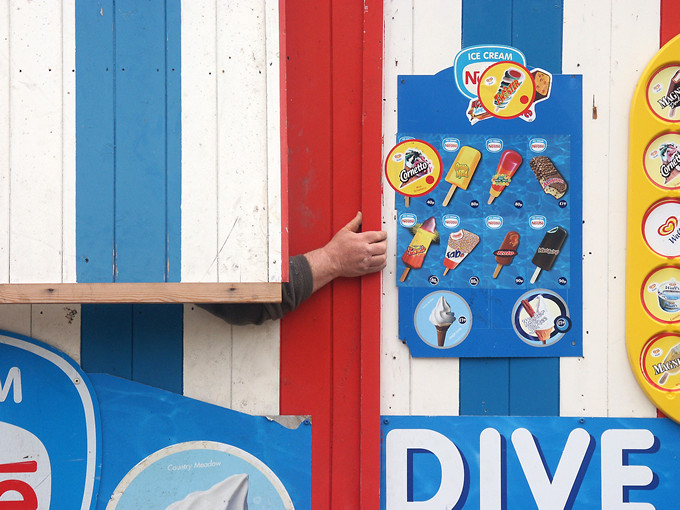
Pricing prints is a tricky business. The first time I had a print exhibited was about 5 years ago in a Royal Photographic Society (RPS) show. I had no idea how much to charge and asked several photographers who had exhibited, as well as the RPS themselves. The consensus seemed to be that £100 was the minimum price point for exhibited material. I think I priced my smallish print (above) at around £140, and I waited for the orders to roll in as the exhibition toured the country. Unfortunately, the response was disappointing... It was interesting to look at the exhibition price list where the prices ranged from around £40 (one of the Silver medal winners was one of the cheapest prints) to the mid-thousands.
As I started to get more queries about print prices via my web site, I was caught in two minds. Namely trying to make some money from the hundreds or thousands of hours of "work" that I'd spent making pictures versus the fact that many enquiries seemed to be from students or fellow photographers, with not a huge amount of cash to throw around. I didn't feel entirely comfortable selling things for prices that I, as a photography enthusiast, couldn't afford.
In the end (and incidentally this is before the estimable Jen Bekman started up http://www.20x200.com/), I slowly came to the conclusion that the ideal solution was to offer small prints for low prices while offering larger prints at prices that I couldn't afford, but possibly other people could...
In addition, as an experiment along the lines of 20×200, I'm offering prints of two photos at very low prices throughout March to see how many (any?) sell. Details to follow tomorrow.
Wednesday, February 27
Photographic disasters – part I
My first and probably worst photographic disaster happened when I was in the sixth form. A long, long time ago. A friend of mine had a collection of dresses that she had made as part of, I think, a foundation arts course for a college in Worthing. Sadly my memory is a little hazy. I agreed to photograph her in the dresses for her portfolio and the venue for the photoshoot was set as Mewsbrook Park in Littlehampton. We did consider the Maldives, but the local park seemed more authentic and edgy.
Anyway, after much inconvenient costume changing in bushes, etc. I shot maybe a dozen pictures of various dresses with my trusty Pentax ME super. After the first shot, the camera wind-on mechanism seemed strangely effortless compared to usual but as I just knew that I had a 36 exposure film in my camera and plenty of shots left, I didn’t think much of it.
Imagine my surprise (etc.) when I got the film developed to find that it was a much shorter roll of film. For the park session, I had immediately tore through the spocket holes and had been shooting fresh air for the whole of the afternoon. Not a single shot.
Oh well, at least we’re still friends - happy birthday Janice!
Anyway, after much inconvenient costume changing in bushes, etc. I shot maybe a dozen pictures of various dresses with my trusty Pentax ME super. After the first shot, the camera wind-on mechanism seemed strangely effortless compared to usual but as I just knew that I had a 36 exposure film in my camera and plenty of shots left, I didn’t think much of it.
Imagine my surprise (etc.) when I got the film developed to find that it was a much shorter roll of film. For the park session, I had immediately tore through the spocket holes and had been shooting fresh air for the whole of the afternoon. Not a single shot.
Oh well, at least we’re still friends - happy birthday Janice!
Monday, February 25
Southampton – the city that cloned itself. Part I
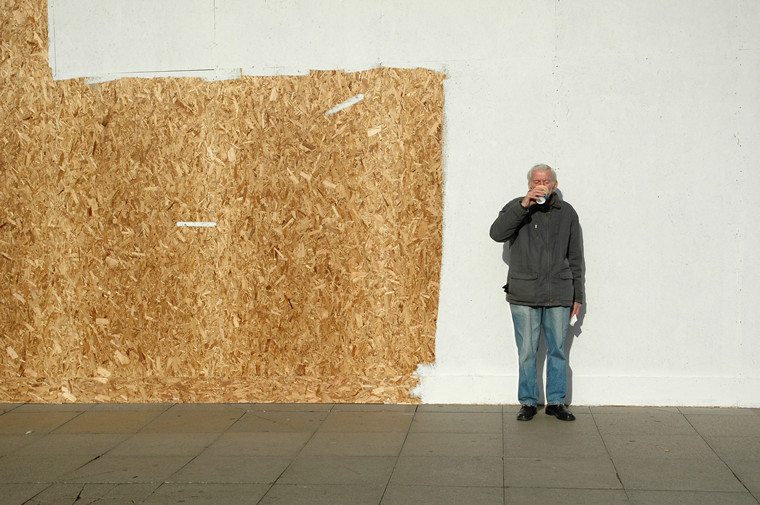
A few years ago, I hopped onto the train to Southampton, intending to take some photos of the busy city centre and have a general mooch around. After several hours of wandering, I started to become puzzled. I had seen shopping centre after centre, chain store after chain store, but where was the, erm, interesting stuff?
Southampton has some pleasant parks, and some interesting historical remnants around the fringes but the city centre is a pretty depressing place. Not even run down – in fact it’s all very modern and clean and prosperous. But so linear and dull and homogeneous for such a large city. Not even a quirky/trendy/irritating quarter like, say, Hockley in Nottingham, Park Street in Bristol or the whole North Laine area of Brighton.
No, Southampton has a city centre where the shopping centre and the identikit chain store is king. I swear I wandered into one shopping centre and emerged from a completely different one. Either I had found a secret passage in the consumer–space continuum or the repetition of shop fronts had induced a mild state of hypnosis.
Anyway, after a couple of hours I spied a non-chain bookshop in a road off the pedestrianized main drag. And it had just closed. For good. Oh well...
Friday, February 22
Quote of the day...
"All cities are mad: but the madness is gallant. All cities are beautiful: but the beauty is grim."
- Christopher Morley (1890 - 1957)
- Christopher Morley (1890 - 1957)
Tuesday, February 5
New phone
I have the very latest in modern technology - a pay-as-you go mobile phone that cost me all of £15 from W H Smith.
Problem is, I had my last phone since 2001, and in those six odd years, I didn't manage to memorise the number.
How can I memorise this new, exciting number:

?????????
Problem is, I had my last phone since 2001, and in those six odd years, I didn't manage to memorise the number.
How can I memorise this new, exciting number:

?????????
Friday, January 25
FRONT: The seaside photos of Justin Sainsbury

Justin Sainsbury (Justin) recently asked me to contribute an Introduction to his self-published book of seaside documentary photography.
Rather than go the usual Blurb/Photobox route, Justin used a professional designer to create the layout, and has had the book printed locally in Sussex.
Typically, I left it to the last minute to produce the text, reproduced below. For an old cynic like myself it’s a bit embarrassingly “jumpers for goalposts” nostalgic, but between you and me, this reflects my genuine enthusiasm for the seaside.
Introduction
Contained within these pages is Justin Sainsbury’s photographic account of life in the seaside resorts of the English south coast.
The photos in this selection are the fruits of many hours of wandering – putting imaginary frame after imaginary frame around the world until something seems to fall into place. And then the photographer raises the camera, the camera clicks, and with skill and a little luck a good picture is the reward.
The photos here capture the simple pleasures of the seaside, deftly and realistically, without resorting to either sentimentality or cruelty. The seaside has proved to be a popular hunting ground for documentary photographers, with a wide range of outcomes. Martin Parr’s take on the resorts shown here would doubtless render them gaudy, litter strewn, run down and depressing. Other photographers (possibly myself included) might play up the idyllic nature of a gentler, nostalgic, imagined age.
It’s a delicate balance, but the spirit of Justin’s photographs reminds me of comments made about the English photographer Tony Ray-Jones, who photographed the English with enthusiasm in the 1960s
" " " " "
[His] pictures have that rare blend of humour and sadness which is born of both compassion and irony. This is something that springs from the depths of character and it is something that cannot be copied or faked. The imitation... is a blend of sentiment and sarcasm, and is totally alien to his work and to his nature
" " " " "
Ainslie Ellis, Introduction to A Day Off
Justin, born in Brighton, and a long-time inhabitant of both there and Worthing, gives us an insider’s view – the unvarnished truth. Or as near as possible as it is to display truth through the medium of photography. As well as kindly looking pensioners, there are teenagers in hoodies, art-school students, rebellious dogs, and a cast of familiar and eccentric locals carrying out their daily routines. This is a straight-ahead, honest, unpretentious version of the English seafront.
Despite regular pieces in the style magazines about how the seaside is trendy again (possibly by writers who haven’t actually visited the particular resort – I would like the see the Vogue magazine staffers braving a boisterous Friday night in Littlehampton), there are many seaside towns that are hanging on by the skins of their teeth. And a few that are doing pretty nicely. All aspects are displayed here – half-dressed fun vs the disappointment of bad weather, the Chuckle Brothers vs the local Philharmonic...
As a serial inhabitant of seaside towns myself, I enjoy the expectancy on faces and in voices when the train or coach arrives down from London – peering out of the window for a glimpse of the sea. When I visited Worthing recently in the height of summer, I was surprised to find the seafront sparsely populated, and many of the seafronts in Justin’s photos don’t seem that lively either. In bad weather the tourist’s day can resemble an endurance test to be conquered with anoraks, packed lunches and flasks of tea. More so than elsewhere, the weather can make or break the seaside experience. At seaside resorts, there are often limited opportunities for indoor leisure, and so the weather is all important. Unlike, say, London, which just looks and feels a bit nicer in good weather, Worthing can seem idyllic in fair weather, but if you chance upon it on a bad day, it can seem deathly grim. And if the fireworks are cancelled, it’s no fun at all...
Meeting up with Justin, I come to realise that he plays down the more extreme artistic pretensions of this sort of street photography, likening it more to a sport. At 6 foot 7, he was much in demand on the basketball court and it’s easy to imagine the successful shots here being like a basketball slam dunk. Street photographers rely on a variety of methods to take photos without alarming their subjects – speed and attempts at ‘invisibility’ usually are key. Given his height, Justin decided that invisibility was not a viable option, and instead he goes about his business of documenting the seafront quite openly – taking candid shots but ready to engage his subjects in conversation when spotted. His natural empathy, interest and respect for his subjects doubtless comes in handy...
Tony Ray-Jones famously said that ‘I have tried to show the sadness and humour in a gentle madness that prevails in people’, and this gentle – and some not so gentle – madness seems particularly apparent at the beach, where a sub-zero midnight swim seems like a good idea after some refreshment, and a romantic walk to the end of the pier will inevitably lead to a kiss. Justin’s photos remind us of all the natural fun and numerous tiny disappointments, again without resorting to sentimentality or cruelty.
The whole seaside experience is here, briefly in black and white, and latterly in colour. The two casts of characters – the die-hard locals and the day-trippers – a black and white café whose patron is contemplating the day ahead, looks that could kill, and the couple enjoying a tender moment on Littlehampton seafront.
Enjoy the experience!
Paul Russell
October 2007
Wednesday, October 17
LIP Annual Exhibition
Quick announcement and general reminder to self:
London Independent Photography Annual Exhibition
14th to 27th October 2007
Venue: Cotton’s Atrium on the riverside close to London Bridge (Tooley Street, London, SE1 2QE)
A wide range of photographers and styles -- 114 pics, about 50 photographers -- as can be seen in this link:
sample photos
Some familiar names there -- David Solomons, Chris Moxey, Gary Alexander and Tiffany Jones.
London Independent Photography Annual Exhibition
14th to 27th October 2007
Venue: Cotton’s Atrium on the riverside close to London Bridge (Tooley Street, London, SE1 2QE)
A wide range of photographers and styles -- 114 pics, about 50 photographers -- as can be seen in this link:
sample photos
Some familiar names there -- David Solomons, Chris Moxey, Gary Alexander and Tiffany Jones.
Sunday, October 7
David Allan Harvey
Magnum good egg David Allan Harvey is offering a $5000 grant to support one photographer's personal work:
Grant
The closing date is 15 November 2007.
Grant
The closing date is 15 November 2007.
Friday, October 5
Nice balloon picture (Jupitus 1, Hoon 0)

Spent a few hours in Bournemouth the other day on the last day of the Labour party conference.
According to the Dorset Echo, "£5.3 million Operation Pegasus ... involved more than 400 officers, 140 police staff and more than 150 civilian security staff."
I don't know if the Labour Party head honchos had got Bournemouth mixed up with Brighton in the summer, but that's a *lot* of security for a smallish seaside town in Autumn. As I wandered around the seafront, the police seemed to outnumber members of the public two to one. A dozen police loitered around the entrance of the near-deserted pier, desperately looking for something to do.
Walking around with a largish camera I felt liable to stopped and questioned at any moment. Possibly my paranoia had been fuelled by reading this report in the Bournemouth local paper
Bournemouth Echo
where two disabled men drinking outside a pub overlooking a hotel where delegates were staying were apparently searched, questioned and had their homes searched for variously "looking at a police officer" and "opening an electricity bill" in a public place.
In the end, rather than risking any people photography – which, let's face it, is a lot more of your typical evildoer activity than opening an electricity bill – I took a few photos of a balloon on the pier.
On a related note, on the way to the town centre from the train station I pass a curry house that has a display of photos of the famous(-ish) people that have eaten there. It always makes me smile that they can put a name to comedic DJ Phil Jupitus but they can't conjure up Geoff Hoon's name. The best they can do is "House of Common (sic) MP". Clearly, slippery Geoff didn't make a big impression.
Sunday, September 23
The city as metaphor for the creative process – the importance of getting lost
Talking of getting lost, a while ago, I keyed in some text from an interesting interview with Tom Waits that I’d torn out of an old issue of Uncut magazine:
""""""""
When they originally met, Brennan [Kathleen Brennan – later to become Tom’s wife] was a script editor at Zoetrope studios. Tom was penning what became the Oscar nominated score for Coppola’s One From the Heart. The album required him to write in a style that he was trying to leave behind, and it was Brennan who helped him find the confidence, security and self-respect to follow his esoteric leanings and make the leap towards 1983’s Swordfishtrombones. Their working relationship developed gradually.
“The love came first”, nods Waits, “but we used to play a game called Let’s Go Get Lost. We’d drive into a town and I would say, “But, baby – I know this place like the back of my hand, I can’t get lost.” And she’d say, “Oh hell, you can’t, turn here, now turn there. Now go back, now turn left, now go right again.” And we’d do that all night, until we got lost...
"""""""
(Source: Gavin Martin, Uncut, June 2002)
Underneath the bluster, Waits seems like a shy, private man, and a spinner of great yarns, so who knows if the story is literally true?
As a frequent visitor to London, I’ve wondered why it is that I always seem to end up in the same spots, despite the hundreds and thousands of possibilities in the centre. For example, despite my current entry point being Waterloo Station, I’ve never encountered nearby Elephant and Castle on my apparently random wanderings and attempts to “get lost”.
Why is this? I guess that given a specific starting point there are only so many initial choices. And when coming to a crossroads or fork, even unconsciously, it’s natural to choose the most “promising” and interesting looking road. A strategy that leads to a similar set of outcomes. In other words, to really explore it must be necessary to deliberately choose some unpromising initial options in order to arrive at new destinations.
I’d love to see a GPS type map plot of my London wanderings, but then I’m a bit a map obsessive.
""""""""
When they originally met, Brennan [Kathleen Brennan – later to become Tom’s wife] was a script editor at Zoetrope studios. Tom was penning what became the Oscar nominated score for Coppola’s One From the Heart. The album required him to write in a style that he was trying to leave behind, and it was Brennan who helped him find the confidence, security and self-respect to follow his esoteric leanings and make the leap towards 1983’s Swordfishtrombones. Their working relationship developed gradually.
“The love came first”, nods Waits, “but we used to play a game called Let’s Go Get Lost. We’d drive into a town and I would say, “But, baby – I know this place like the back of my hand, I can’t get lost.” And she’d say, “Oh hell, you can’t, turn here, now turn there. Now go back, now turn left, now go right again.” And we’d do that all night, until we got lost...
"""""""
(Source: Gavin Martin, Uncut, June 2002)
Underneath the bluster, Waits seems like a shy, private man, and a spinner of great yarns, so who knows if the story is literally true?
As a frequent visitor to London, I’ve wondered why it is that I always seem to end up in the same spots, despite the hundreds and thousands of possibilities in the centre. For example, despite my current entry point being Waterloo Station, I’ve never encountered nearby Elephant and Castle on my apparently random wanderings and attempts to “get lost”.
Why is this? I guess that given a specific starting point there are only so many initial choices. And when coming to a crossroads or fork, even unconsciously, it’s natural to choose the most “promising” and interesting looking road. A strategy that leads to a similar set of outcomes. In other words, to really explore it must be necessary to deliberately choose some unpromising initial options in order to arrive at new destinations.
I’d love to see a GPS type map plot of my London wanderings, but then I’m a bit a map obsessive.
Wednesday, September 12
Small World
I was surprised to see a medium-size pile of Martin Parr's "Small World" book in Borders in Bournemouth today. Assuming it to be some sort of clerical error or random stockroom discovery, I grabbed a copy and learnt that it has just been republished.
I guess that Mr Parr's appearance on the forthcoming Channel 4 photography reality TV competition "Picture This" (where he will doubtless play the Bad Cop) means that publishers are anticipating a surge of interest.
I guess that Mr Parr's appearance on the forthcoming Channel 4 photography reality TV competition "Picture This" (where he will doubtless play the Bad Cop) means that publishers are anticipating a surge of interest.
Sunday, September 9
Northern Ireland part I: off the page in Belfast

I recently returned from a short trip to Northern Ireland to see my exhibition at the Clotworthy in Antrim. The exhibition looked good and everything went swimmingly. Well, apart from that fact that I developed a hideous sore throat and cold on the day I travelled out, and generally felt 100% ropey.
I then spent an interesting 24 hours in Belfast, made more interesting by the fact that I set a world record for getting lost. It's so long since I've been anywhere new that I forgot one of my own golden rules for travel; namely acquire a *good* map of the city before travelling.
I had a Rough Guide to Ireland, which had a map of Belfast city centre and a map of the University district. Which was fine until I came to the edge of one map, and the edge of another. Unfortunately there seemed to be zero overlap, so I spent a disproportionate amount of time lost in limbo between those pages. Mainly in the vicinity of the BBC building.
Thank you to the kind soul from a film crew who advised me that I was about to head into a red-light road and pointed me in the correct direction. It transpired that he was filming a piece about inner-city violence, which made me chuckle.
Tuesday, August 28
Learning with Winogrand
O.C. Garza, a former pupil of Garry Winogrand, has just written about his classroom experiences.
The PDF is here:
PDF
Link via Michael David Murphy's While Seated blog
The PDF is here:
Link via Michael David Murphy's While Seated blog
Monday, August 27
That's Entertainment
It's interesting to see what happens when different photographers bump into the same backgrounds...
 Chris Moxey
 Paul Russell
 Hinius
 Chris Moxey
 Paul Russell
 Hinius
Sunday, August 12
Endless summer sale (must end 1 September)
I'm just sorting out eight summer-tinged (15 × 10 inch) photos for a soar-away summer print sale.
The prints will only be available at unfeasibly reasonable prices for 2 weeks, so please email me if you're interested.
In the meantime, just in case you haven't come across them before, feel free to peruse Maciej Dakowicz's amazing Cardiff nightlife photos:
Cardiff
EDIT: thanks to the couple of people who took me up on the offer!
The prints will only be available at unfeasibly reasonable prices for 2 weeks, so please email me if you're interested.
In the meantime, just in case you haven't come across them before, feel free to peruse Maciej Dakowicz's amazing Cardiff nightlife photos:
Cardiff
EDIT: thanks to the couple of people who took me up on the offer!
Sunday, August 5
A seaside show in Antrim
I finally got round to sorting out the pictures for another show of my seaside pictures, this time in Antrim, Northern Ireland, which runs from
4 September to 28 September
Clotworthy Arts Centre, Antrim
The gallery has been very helpful and generous.
Of course, despite my best intentions and a carefully prepared schedule, finding the time to prepare and upsize the files to be printed by at 15 by 10 inches by my local lab eventually was squeezed to a slightly last-minute affair. Not helped by the fact that my antique computer seems to be on its last legs, and huge chunks of hard drive disappear for no apparent reason, seemingly just when I need to do some urgent work.
In the end I was very pleased with the final 36 prints, which takes some the best pictures from the Slough and Bracknell shows but gives a run out to some (mainly) newer shots.
The Nikon D70 files go to 15 by 10 inches pretty easily, at least to my eye looking at the final prints, so the time I spent agonising over whether to apply 65% or 70% unsharp mask for such and such a shot is 100% invisible to the naked eye.
4 September to 28 September
Clotworthy Arts Centre, Antrim
The gallery has been very helpful and generous.
Of course, despite my best intentions and a carefully prepared schedule, finding the time to prepare and upsize the files to be printed by at 15 by 10 inches by my local lab eventually was squeezed to a slightly last-minute affair. Not helped by the fact that my antique computer seems to be on its last legs, and huge chunks of hard drive disappear for no apparent reason, seemingly just when I need to do some urgent work.
In the end I was very pleased with the final 36 prints, which takes some the best pictures from the Slough and Bracknell shows but gives a run out to some (mainly) newer shots.
The Nikon D70 files go to 15 by 10 inches pretty easily, at least to my eye looking at the final prints, so the time I spent agonising over whether to apply 65% or 70% unsharp mask for such and such a shot is 100% invisible to the naked eye.
Thursday, July 19
The Road to Kafka’s Pier
A while back I thought I’d “do the right thing” about photographing on private property – in this case a pier. As I’d spent many hours on this pier, it struck me that they may have a policy about usage of photos in publications.
I’ve seen numerous published photos taken on Brighton Pier*, for example, so presumably there’s no problem there. On the other hand, as you enter Southsea Pier near Portsmouth, there’s a badly written notice warning you about commercial use of pictures taken on the pier.
Here’s (roughly) happened in the beach front office, staffed by about six people. The full Kafka-esque dialogue was probably four times as long...
M: Hello. I’m doing a project on seaside towns and I was wondering, in the unlikely event that the photos ever get published in a magazine or book, if there’s any problem with using pictures taken on the pier, as it’s private property.
T: When are you going to be doing the photography?
M: Well, it’s nothing that formal really. I’ve spent some time on the pier over the last few months taking photos. I just wondered if there are any restrictions about using photos in magazines and stuff like that.
T: Because if you’re going to be doing it now, we can ring across to the pier and tell them that you’re coming, and get permission.
M: Erm. Well, I just have this small camera. Permission? There’s dozens of people taking pictures on the pier. I don’t need permission do I? I just want to know if I can use any photographs I take in publications as the pier is private property.
[various conferring about who to phone, long phone conversation]
T: OK, don’t take pictures of people without their permission, especially children. Be very careful about that.
M: [sidestepping] Well I do a lot of photography and I don’t intend to break any laws, but I’m trying to find out if there are any laws that are specific to the pier, as it’s private property.
[various conferring about who to phone, long phone conversation]
T: OK, we give you permission. Go and do it! Do you want us to phone the pier?
M: Erm, is there any problem with me using photos in publications?
T: [very uncertain voice] No.
So really, I’m none the wiser...
*Formerly Palace Pier – presumably renamed just in case you forget what city you’re in.
I’ve seen numerous published photos taken on Brighton Pier*, for example, so presumably there’s no problem there. On the other hand, as you enter Southsea Pier near Portsmouth, there’s a badly written notice warning you about commercial use of pictures taken on the pier.
Here’s (roughly) happened in the beach front office, staffed by about six people. The full Kafka-esque dialogue was probably four times as long...
M: Hello. I’m doing a project on seaside towns and I was wondering, in the unlikely event that the photos ever get published in a magazine or book, if there’s any problem with using pictures taken on the pier, as it’s private property.
T: When are you going to be doing the photography?
M: Well, it’s nothing that formal really. I’ve spent some time on the pier over the last few months taking photos. I just wondered if there are any restrictions about using photos in magazines and stuff like that.
T: Because if you’re going to be doing it now, we can ring across to the pier and tell them that you’re coming, and get permission.
M: Erm. Well, I just have this small camera. Permission? There’s dozens of people taking pictures on the pier. I don’t need permission do I? I just want to know if I can use any photographs I take in publications as the pier is private property.
[various conferring about who to phone, long phone conversation]
T: OK, don’t take pictures of people without their permission, especially children. Be very careful about that.
M: [sidestepping] Well I do a lot of photography and I don’t intend to break any laws, but I’m trying to find out if there are any laws that are specific to the pier, as it’s private property.
[various conferring about who to phone, long phone conversation]
T: OK, we give you permission. Go and do it! Do you want us to phone the pier?
M: Erm, is there any problem with me using photos in publications?
T: [very uncertain voice] No.
So really, I’m none the wiser...
*Formerly Palace Pier – presumably renamed just in case you forget what city you’re in.
Monday, July 9
Note to self: some places/events to photograph this summer
Cowes Week
4 to 11 August - sample one or two days dependent on good weather
Cowes Week
The Melplash Show
Thurday 23 August - the show is going ahead, despite the foot and mouth restrictions resulting in the absence of sheep and cattle. I'll have to focus on the horse action this year. Hoping for good weather.
Melplash Show
Last year
Corfe Castle and village
Corfe
Swanage Carnival
28 July to 4 August
Swanage
On a dry Saturday.
Lyme Regis
21 to 29 July - Lifeboat Week
4 to 12 August - Regatta and Carnival week
(Also 29 September to 7 October Arts Fest - open studios, workshops and events.)
Although any time is a good time to visit Lyme Regis
Lyme
Also, I must get over to visit Bognor, Littlehampton and Brighton before the "season" is over...
4 to 11 August - sample one or two days dependent on good weather
Cowes Week
The Melplash Show
Thurday 23 August - the show is going ahead, despite the foot and mouth restrictions resulting in the absence of sheep and cattle. I'll have to focus on the horse action this year. Hoping for good weather.
Melplash Show
Last year
Corfe Castle and village
Corfe
Swanage Carnival
28 July to 4 August
Swanage
On a dry Saturday.
Lyme Regis
21 to 29 July - Lifeboat Week
4 to 12 August - Regatta and Carnival week
(Also 29 September to 7 October Arts Fest - open studios, workshops and events.)
Although any time is a good time to visit Lyme Regis
Lyme
Also, I must get over to visit Bognor, Littlehampton and Brighton before the "season" is over...
Thursday, June 7
How we are now?
There's a major photography exhibition currently showing at Tate Britain (that's Tate Britain at Millbank, not Tate Modern)
How We Are: Photographing Britain
Curated by Val Williams and Susan Bright
22 May 2007 to 2 September 2007
http://www.tate.org.uk/britain/exhibitions/howweare/
Tate Britain is open daily, 10.00-17.50
Exhibitions 10.00-17.40 (last admission 17.00)
Ticket prices: Adult £7.50; Student, over 60, unwaged, child 12-18 and disabled £6.
"As well as famous names - William Henry Fox Talbot, Lewis Carroll, Julia Margaret Cameron, Bill Brandt, Madame Yevonde, Susan Lipper, David Bailey and Tom Hunter among them - the exhibition includes postcards, family albums, medical photographs, propaganda and social documents. It includes work by many women photographers and photographers from different cultural backgrounds who are usually underplayed in the history of British photography."
By coincidence (see post below), one of Roger Mayne's Southam Street photos features in the publicity for the show.
Interestingly, the show features four large screens that are displaying slideshows from this Flickr group:
http://www.flickr.com/groups/howwearenow/
which is open to all.
How We Are: Photographing Britain
Curated by Val Williams and Susan Bright
22 May 2007 to 2 September 2007
http://www.tate.org.uk/britain/exhibitions/howweare/
Tate Britain is open daily, 10.00-17.50
Exhibitions 10.00-17.40 (last admission 17.00)
Ticket prices: Adult £7.50; Student, over 60, unwaged, child 12-18 and disabled £6.
"As well as famous names - William Henry Fox Talbot, Lewis Carroll, Julia Margaret Cameron, Bill Brandt, Madame Yevonde, Susan Lipper, David Bailey and Tom Hunter among them - the exhibition includes postcards, family albums, medical photographs, propaganda and social documents. It includes work by many women photographers and photographers from different cultural backgrounds who are usually underplayed in the history of British photography."
By coincidence (see post below), one of Roger Mayne's Southam Street photos features in the publicity for the show.
Interestingly, the show features four large screens that are displaying slideshows from this Flickr group:
http://www.flickr.com/groups/howwearenow/
which is open to all.
Subscribe to:
Posts (Atom)